
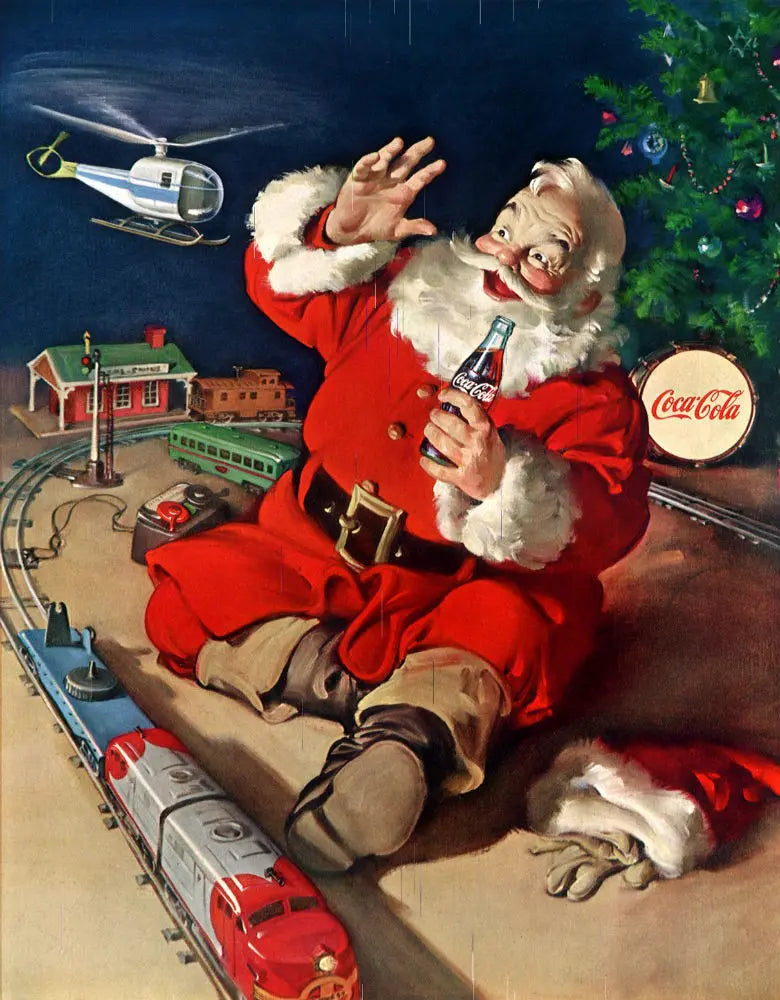
The belief that Coca-Cola invented or created the character of Santa Claus is a popular idea, but it is largely a myth. In reality, the modern depiction of Santa Claus, as he is generally recognized today, is the result of a cultural evolution that took place over several centuries, long before Coca-Cola's involvement.
However, Coca-Cola played a significant role in popularizing and commercializing the image of Santa Claus as he is commonly perceived in contemporary culture. In 1931, artist Haddon Sundblom created a series of advertisements for Coca-Cola featuring a jovial Santa Claus, dressed in a red suit with a black belt, an image that largely contributed to shaping the modern representation of this character.
These Coca-Cola advertisements helped popularize a specific vision of Santa Claus. Before this, the character was already rooted in popular tradition, but he was depicted in various ways in culture and folklore, sometimes wearing clothes of different colors or having various appearances depending on the region.
The Santa Claus as presented by Coca-Cola successfully became an iconic figure of the holiday season, widely recognized and adopted by many cultures around the world. It is important to note that this version of Santa Claus's image, with his bright red suit and joviality, was not invented by Coca-Cola, but it was reinforced and popularized by their advertising campaigns.
Thus, although Coca-Cola played a major role in disseminating a highly recognizable depiction of Santa Claus, the idea that the company invented the character is an exaggeration. Santa Claus as we know him today is the result of a combination of diverse traditions and representations that have evolved over the centuries.
The iconic figure of Santa Claus is the result of a complex evolution, blending different traditions, folklore, and cultural influences over the centuries.
-
Historical and Folkloric Origins: The roots of Santa Claus go back to various traditions and legends. The character is largely based on Saint Nicholas, a 4th-century bishop known for his generosity towards children and for being the patron saint of children and sailors. Saint Nicholas, celebrated on December 6th, is associated with the tradition of giving gifts, particularly to children.
-
Legends from Around the World: Throughout the world, there are many folkloric figures similar to Santa Claus, often associated with the celebration of the winter solstice or religious festivities. For example, in Europe, Krampus in Germany or Père Fouettard in France are contrasting figures associated with the Christmas period.
-
Literary Influences: Writings and tales have also contributed to shaping the modern vision of Santa Claus. Works like "A Visit from St. Nicholas" (better known as "Twas the Night Before Christmas") attributed to Clement Clarke Moore in the 19th century, popularized the image of a jolly, plump Santa Claus, delivering gifts.
-
Cultural Evolution: European immigrants brought their Saint Nicholas traditions with them to North America, where these customs blended and evolved over time to give rise to the more familiar figure of Santa Claus.
-
Coca-Cola and Modern Iconography: In 1931, Coca-Cola launched an advertising campaign featuring a joyful Santa Claus, drawn by artist Haddon Sundblom. These advertisements helped shape the popular image of Santa Claus wearing a bright red and white suit, which reinforced a very recognizable visual representation of the character.
Thus, Santa Claus is the result of a long process of cultural evolution, combining elements of folklore, religious traditions, literature, and even advertising, culminating in the warm and benevolent figure associated with generosity and gift-giving during the holiday season. This global icon embodies the spirit of Christmas and has transcended cultural boundaries to become a universal symbol of the holiday season.