
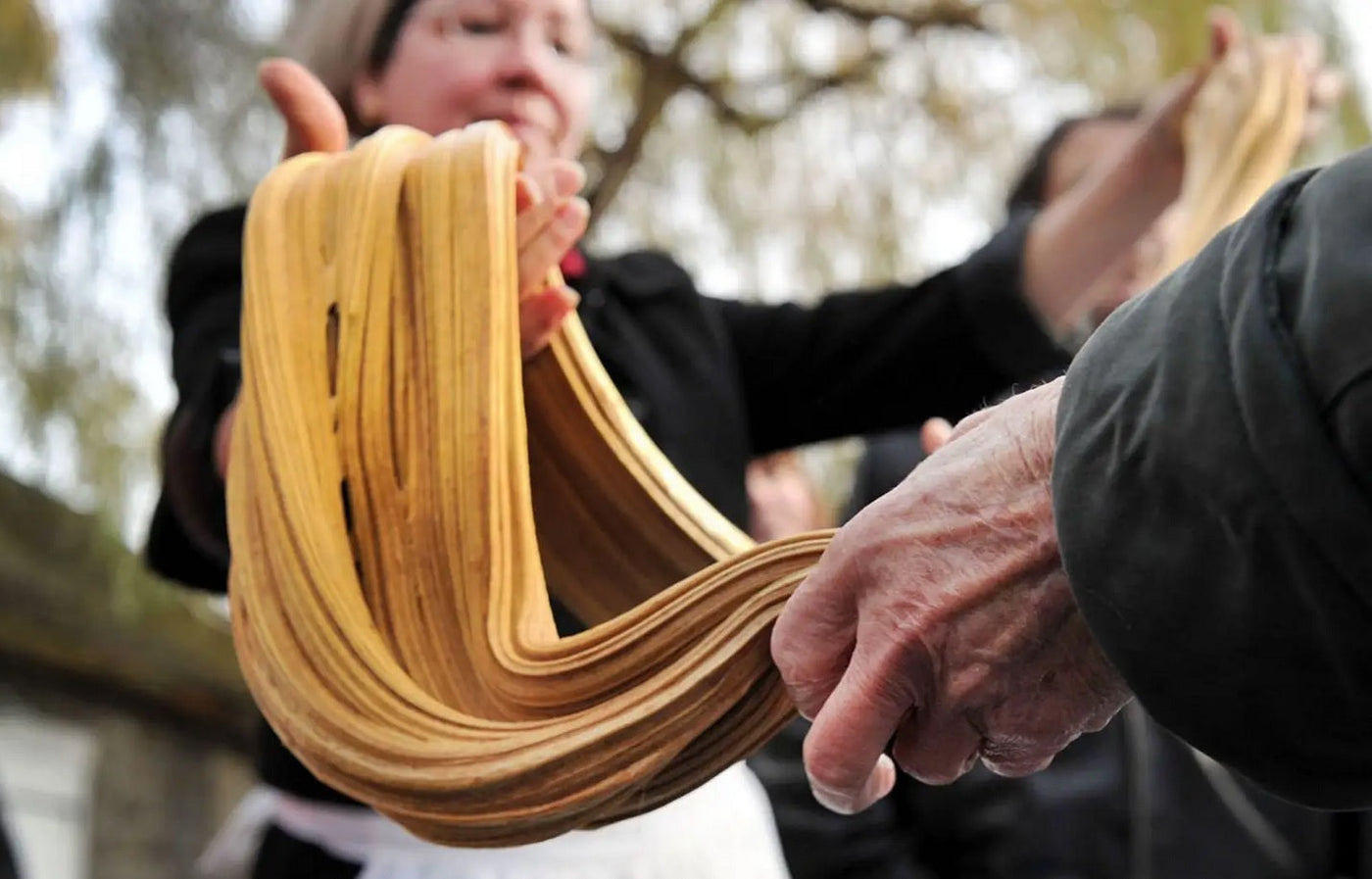
Tire Sainte-Catherine (Saint Catherine's taffy) is a traditional Quebec culinary treat dating back to the French colonial era in North America. This sweet is a soft toffee, often prepared for Saint Catherine's Day on November 25.
The history of Tire Sainte-Catherine goes back to New France, when the nuns of the Hôtel-Dieu de Québec created this confection to reward children who had worked hard in their school. Originally, the taffy was made with boiled maple syrup and packed snow, which was used to cool the syrup by stirring it with a wooden spatula.
Over time, the recipe for Tire Sainte-Catherine evolved, and snow was replaced by cold water. The maple syrup is boiled until it reaches a precise temperature, then it is poured over snow or cold water. The syrup is then worked with a wooden spatula until it takes on a soft, sticky texture. It can then be shaped into small rolls or balls.
Tire Sainte-Catherine is often eaten in winter, during sugar season, when maple producers harvest sap from maple trees and turn it into syrup. It is often enjoyed as a dessert or snack.
Today, Tire Sainte-Catherine is considered an emblem of Quebec culinary culture and is sold in many stores and grocery stores in Quebec. It is also consumed in other parts of Canada, as well as in the northeastern United States, where Quebec culture has had a strong influence.